
Perimenopause, Cortisol, and the Nervous System
Why weight gain isn't a willpower issue, and why nervous system repair matters more than stress "management"
You've noticed something shifting.
Your body responds differently than it used to. Sleep fragments. Emotions hit harder. The weight you could always manage through discipline and strategy now redistributes in ways that don't respond to familiar approaches.
Recovery from everything, a stressful day, disrupted sleep, a difficult conversation, takes longer than it once did.
The strategies that worked for years have stopped working. Not because you're doing them wrong, but because perimenopause has fundamentally altered the physiological landscape you're operating in.
To understand what's actually happening, we need to look at cortisol. Not the oversimplified villain you've been sold, but the sophisticated stress hormone doing exactly what it's designed to do in a system that's undergone significant change.
Understanding cortisol's actual role
Cortisol is your body's primary stress hormone, released by your adrenal glands in response to perceived threat. Its job is to mobilise energy quickly:
It raises blood sugar so you have fuel available
It sharpens focus and reaction time
It diverts resources away from non-essential functions (digestion, reproduction, tissue repair)
It keeps you responsive and ready
In acute stress, this is precisely what you need. The system activates, you respond, and then, critically, it settles.
The problem isn't cortisol itself.
The problem is a nervous system that no longer recognises when the danger has passed, leaving cortisol chronically elevated without the corresponding reset.
How perimenopause changes the stress response
Before perimenopause, oestrogen provided significant buffering to your stress response system (the HPA axis — hypothalamic-pituitary-adrenal axis).
Oestrogen:
Modulated cortisol reactivity
Shortened the duration of cortisol pulses
Protected against the inflammatory effects of chronic stress
Supported neuroplasticity and emotional regulation
Maintained a wider window of stress tolerance
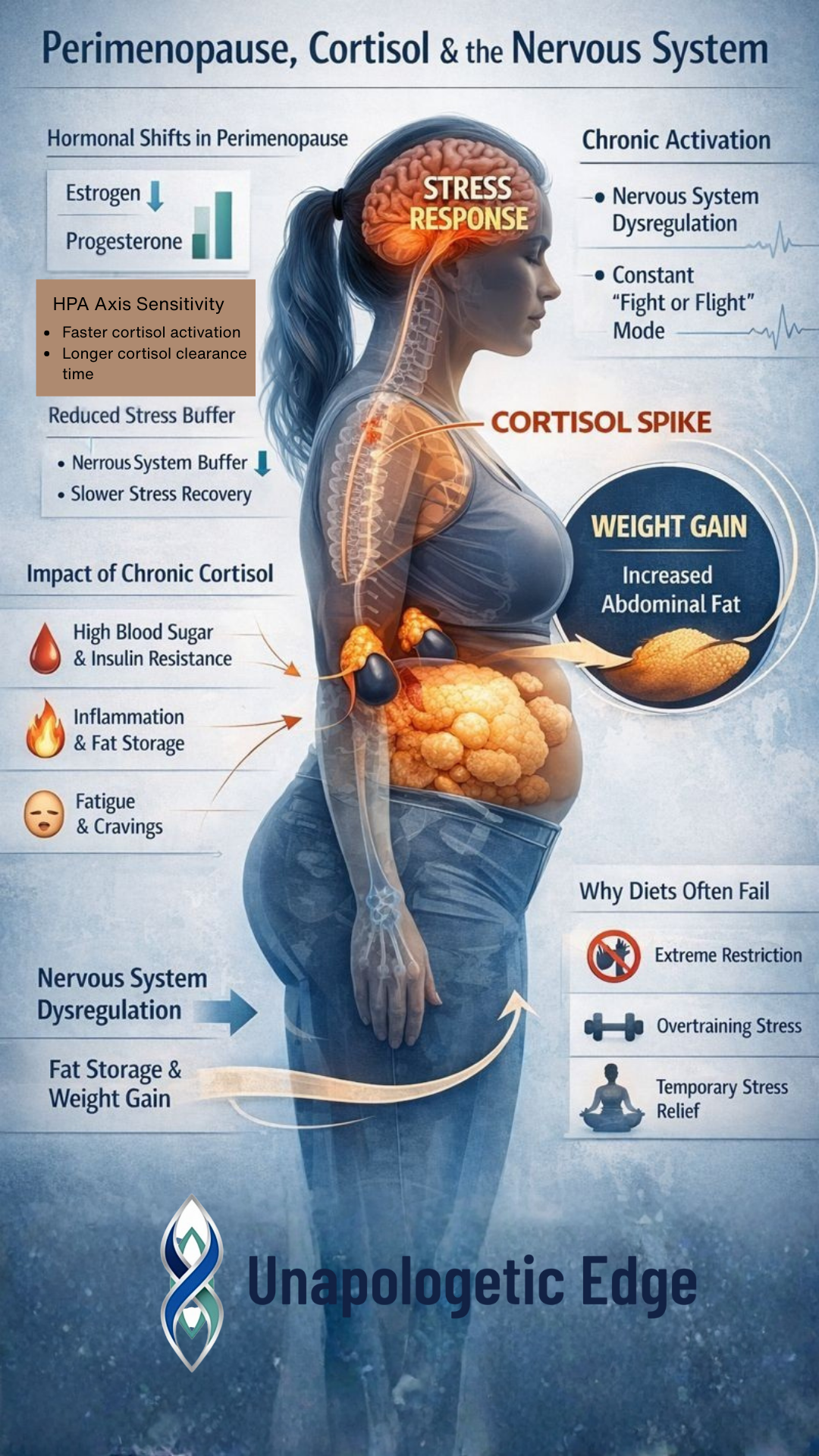
As oestrogen declines and fluctuates during perimenopause, this buffering diminishes. The HPA axis becomes more reactive. The window of tolerance narrows. Stress recovery slows.
What this means in practice:
The same life demands that you once absorbed relatively quietly now produce much bigger physiological responses. The workload hasn't changed. Your body's capacity to process it has.
This isn't a weakness. It's biology.
The cortisol-to-weight-gain cascade
Here's the specific mechanism that drives perimenopausal weight changes:
1. Cortisol rises in response to stress Your body perceives threat (work pressure, sleep deprivation, emotional strain, physical overexertion) and releases cortisol.
2. Blood sugar rises Cortisol signals your liver to release stored glucose, raising blood sugar to provide quick energy.
3. Insulin follows Your pancreas releases insulin to manage the elevated blood sugar.
4. If this happens occasionally: The system resets. Insulin clears the glucose, cortisol returns to baseline, everything recalibrates.
5. If this happens repeatedly: Your cells become less responsive to insulin (insulin resistance develops). To compensate, your pancreas produces more insulin. Chronically elevated insulin actively blocks fat burning and promotes fat storage, particularly visceral fat around the abdomen.
6. Your body prioritises storage Not because it's malfunctioning, but because repeated cortisol spikes signal to your body that resources are scarce and threat is ongoing. Storage becomes a survival strategy.
This is why you experience:
Central weight gain that doesn't respond to calorie restriction
Inflammation and puffiness
Strong cravings, especially for quick energy (carbohydrates) later in the day
Fatigue paired with wired, restless energy
Poor exercise tolerance — workouts that once energised you now deplete you
A sense that your body is actively working against your efforts
Understanding this cascade matters because it shifts the question from "What am I doing wrong?" to "What is my nervous system responding to?"
Why common cortisol-lowering strategies often backfire
The standard advice for managing cortisol is well-intentioned:
Clean up your diet
Try intermittent fasting
Exercise smarter
Practice meditation
Improve your sleep
Some of these can help. Some can make things significantly worse.
Most fail because they assume your nervous system is fundamentally well-regulated and just needs better inputs.
For many women, particularly those with unresolved trauma, chronic overfunctioning patterns, or nervous systems organised around early threat, this assumption is incorrect.
Here's what happens when you add physiological stress to an already dysregulated system:
Aggressive calorie restriction while running on stress hormones signals a state of famine. Cortisol rises further to protect against perceived scarcity.
Intermittent fasting beyond your body's current tolerance extends the cortisol-driven fasted state, potentially worsening insulin resistance and increasing muscle breakdown.
High-intensity exercise when you're already in a state of physiological stress adds more demand to an overtaxed system. Instead of building resilience, it deepens depletion.
Forced relaxation practices when your nervous system genuinely doesn't feel safe to downshift can create internal conflict, the system perceiving that letting go equals danger.
Your body interprets these well-intentioned strategies as additional threats, not solutions.
The result: cortisol stays elevated, weight becomes more resistant, and you feel increasingly disconnected from your body's signals.
The deeper layer: unresolved nervous system patterns
This is where most approaches to perimenopause miss the mark.
Perimenopause doesn't create nervous system dysregulation from nothing. It removes the hormonal scaffolding that was compensating for patterns that were already there.
For many high-performing women, these patterns include:
Chronic hypervigilance — scanning constantly for threat or what needs managing
Perfectionism and overcorrection — learned in environments where mistakes felt dangerous
Overfunctioning — taking responsibility beyond your actual role to prevent collapse or conflict
Emotional suppression — prioritising others' needs while minimising your own
Achievement as safety — competence and productivity as proof of worth and protection from rejection
These aren't character flaws. They're nervous system adaptations to earlier environments where these strategies genuinely helped you survive or stay connected.
The problem is that these patterns keep the stress response chronically activated.
Your nervous system remains organised around unresolved threat. Even when your current life is objectively safe, your body continues responding as though danger is present.
This is what drives chronically elevated cortisol.
Not current stress alone, but the unresolved imprints that make current stress register as existential.
What unresolved threat actually means physiologically
When trauma occurs, whether a single overwhelming event or repeated experiences of fear, helplessness, or relational rupture, your nervous system encodes the experience as an implicit memory.
Unlike explicit memories (what happened), implicit memories live in your body as:
Physiological activation patterns
Emotional reactivity
Behavioural responses
Unconscious core beliefs about safety, worth, and belonging
These imprints operate outside conscious awareness. You don't think them. You feel them, react from them, and organise your life around them.
When these imprints aren't resolved, your nervous system continues to treat the present as though the past threat is still active.
The amygdala (your brain's threat detection centre) remains sensitised. The HPA axis stays primed. Cortisol pulses more frequently and lasts longer.
This is why traditional approaches focused on conscious thought, behaviour change, or stress management often provide only temporary relief.
They're addressing the conscious mind (5% of your processing happens there) while leaving the unconscious patterns (95% of happens here) intact.
Nervous system repair vs stress management
Stress management teaches you to cope with dysregulation.
Nervous system repair resolves the pattern creating the dysregulation.
This distinction matters enormously.
Stress management approaches include:
Breathing techniques
Meditation and mindfulness
Cognitive reframing
Lifestyle optimisation
Boundary setting
Time management
These can be helpful for day-to-day regulation. But they require ongoing practice because they don't change the underlying imprint that keeps activating the stress response.
Nervous system repair addresses the source:
The unresolved traumatic imprints keeping your system in threat mode
The unconscious core beliefs driving protective patterns
The implicit memories your body is still responding to
When these imprints are resolved, the nervous system naturally settles. Not because you've learned to manage it better, but because the perceived threat no longer exists.
How TRTP works differently
TRTP (The Richards Trauma Process) is a clinical intervention designed specifically to resolve traumatic imprints at the unconscious level.
Unlike approaches that rely on:
Re-exposure to traumatic material (which can re-traumatise)
Cathartic emotional release (which often reactivates without resolving)
Cognitive reframing (which addresses conscious thought but not unconscious patterns)
Ongoing regulation techniques (which manage symptoms rather than resolve causes)
TRTP uses specific steps to:
Access the unconscious mind where traumatic imprints are stored
Locate the core unresolved experiences driving current patterns
Resolve the imprint by completing the interrupted survival response
Install new unconscious beliefs about safety, worth, and agency
Test the resolution to ensure the pattern no longer activates
Most patterns resolve in 3-4 sessions. Not because the work is superficial, but because you're addressing the actual source rather than managing downstream effects.
When the imprint resolves, several things happen:
The amygdala recalibrates. Your threat detection becomes more accurate, responding to actual danger rather than pattern-matching to past experience.
The HPA axis settles. Cortisol pulses become appropriate to current circumstances rather than being driven by historical threat.
Your window of tolerance expands. You can hold more complexity, uncertainty, and emotional intensity without dysregulating.
What shifts when the nervous system resets
When your nervous system exits chronic threat mode, downstream physiological changes occur without force:
Metabolically:
Insulin sensitivity improves
The cortisol-insulin cascade interrupts
Fat storage patterns shift
Energy becomes more stable
Appetite and satiety signals clarify
Physically:
Inflammation reduces
Sleep architecture repairs
Exercise becomes restorative rather than depleting
Physical recovery improves
The body stops feeling like it's working against you
Emotionally:
Reactivity decreases
Emotional range expands
The constant internal vigilance quiets
Capacity for rest increases
Connection feels safer
Relationally:
Boundaries become clearer and easier to maintain
People-pleasing and overcorrection decrease
Authentic expression feels less risky
Conflict becomes more navigable
Weight may change. Sometimes it shifts relatively quickly. Sometimes the body stabilises first, prioritising repair before release. Sometimes body composition changes without a significant weight change.
What matters most is this: your body stops fighting itself.
The internal war ends.
Why does this matter specifically in perimenopause?
Perimenopause is a biological threshold.
The hormonal changes aren't just about the end of reproduction. They represent a fundamental reorganisation of your system, neurologically, metabolically, psychologically.
For women with unresolved trauma, and this includes birth trauma, developmental trauma, chronic emotional neglect, relational betrayal, or decades of overfunctioning in systems that demanded too much, perimenopause exposes what was previously being compensated for.
This isn't punishment. It's information.
Your body is showing you what needs resolution.
Trying to override your body at this stage, through restriction, force, or willpower, typically deepens dysregulation.
Working with your nervous system restores the cooperation required for genuine regulation.
A more complete picture of cortisol
Cortisol doesn't need to be "hacked," "balanced," or "fixed."
It needs to be contextualised.
For many women, the most effective way to shift cortisol patterns isn't through another protocol, another restriction, another thing to manage.
It's through resolving the internal conditions that keep triggering the stress response in the first place.
When your nervous system no longer perceives constant threat, because the unresolved imprints have been addressed, cortisol naturally regulates.
Your body remembers how to calibrate itself.
The system you were born with, designed for resilience and adaptation, comes back online.
What becomes possible?
Perimenopause doesn't mean your body is failing you.
It means the margin for ignoring deeper patterns has closed.
That narrowing isn't a flaw in the design. It's an invitation to address what's been unresolved.
When you do that work, when you actually resolve the nervous system patterns rather than layering more management strategies on top of dysregulation, your relationship with your body fundamentally changes.
Not because you've gained more control.
Because you've restored the conditions for genuine regulation.
That's not the end of the challenge or discomfort.
It's the end of your body being the enemy.
And that changes everything.
