
Activated emotions and triggers are not the same thing
And confusing them keeps women stuck in self-monitoring instead of self-trust
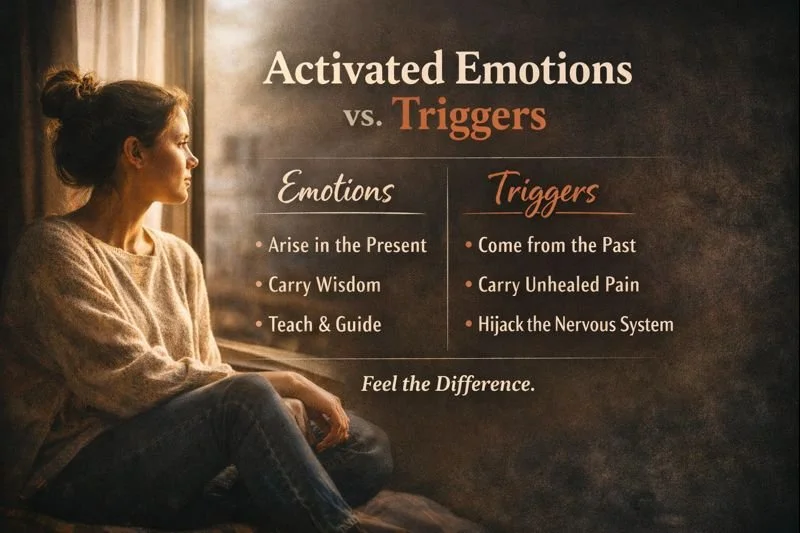
Image describing Emotions Vs Triggers
The word triggered has become a catch-all.
Any strong reaction gets labelled as one. Anger. Grief. Jealousy. Boundary heat. Tears in a meeting. Even joy if it feels too big.
But when everything is a trigger, nothing gets understood. Worse, you start treating your own nervous system like it's broken.
There's a meaningful difference between an activated emotion and a trigger. Understanding it requires knowing a bit about how your nervous system actually works.
How emotions work in a regulated nervous system
Your nervous system operates within what neuroscientists call a window of tolerance, a zone where you can think, feel, and respond simultaneously.
Within this window, emotions arrive as information. They're the work of your prefrontal cortex (your thinking brain) communicating with your limbic system (your emotional brain) in real time. The information flows in both directions.
Anger signals a boundary crossing. Grief signals loss and attachment. Fear signals a genuine threat. Sadness signals a need for support or rest.
Your thinking brain can receive these signals, make sense of them, and choose how to respond. You feel it, and you can think about it happening. That's the window of tolerance at work.
This isn't suppression. It's not "calm and unbothered." It's the ability to be emotionally alive while maintaining access to your prefrontal cortex. You can feel fully and still choose your actions.
This is emotional adulthood. And it's absolutely normal.
What happens when you leave the window: the trigger response
A trigger is what happens when your nervous system drops out of that window entirely.
Neuroscientifically, triggers activate the amygdala, your threat-detection system, in a way that bypasses your prefrontal cortex. Your thinking brain goes offline. Your nervous system shifts into a survival state: fight, flight, freeze, or collapse.
This isn't a personality flaw. It's what happens when your nervous system learned, at some point, that the environment wasn't safe enough to think your way through.
Triggers come from unresolved experiences, moments where there was too much, too fast, too alone, or too overwhelming for your system to process at the time. Your nervous system filed it away incomplete, in a protective state.
When something in the present resembles that unfinished experience, a tone of voice, a facial expression, a timing, even a smell, your amygdala recognises the pattern and reactivates the original survival response.
Time collapses. You're no longer in the present moment. You're neurologically back in the past.
You might notice:
Intensity that feels completely outsized to what's actually happening
Urgency, defensiveness, shutdown, or rage arriving before your thinking brain engages
A sudden loss of perspective or proportion
Your body moving before your mind catches up
Repeating reactions you've promised yourself you'd resolved after last time
Shame about your response, followed by fierce (often exhausting) self-control attempts
The shame is important to name: there's nothing weak or immature about this response. It's survival neurology. Your nervous system is doing exactly what it was designed to do when it perceives a threat.
The problem is that the threat isn't actually in the present moment, even though your body is responding as if it is.
Why insight alone doesn't heal triggers
This is crucial: understanding a trigger doesn't resolve it.
Your prefrontal cortex, the part that learns in therapy, reads self-help books, and has insights, is literally offline when a trigger activates. You can have complete intellectual clarity about why you react a certain way and still have your nervous system override that understanding in the moment.
This is why women say things like: "I know logically that this shouldn't upset me" or "I've done so much work on this and I still react this way."
The trigger lives in your nervous system, not your thoughts. Thinking your way out of it is like trying to talk your way out of the flu.
Actual healing requires the nervous system to complete what it couldn't finish at the time. To move from a protective state back into safety. Not intellectually, unconsciously and somatically. In your body and the part of the mind that runs the body.
The difference in the body
An activated emotion (within your window of tolerance):
Has charge, but it's proportional to the moment
Allows you to feel and think simultaneously
Creates a sense of agency even if the feeling is uncomfortable
Moves through and settles when it's been heard
A trigger (outside your window):
Has intensity that feels disconnected from the present situation
Hijacks your thinking brain temporarily
Creates a sense of being run by the feeling rather than experiencing it
Repeats in similar patterns despite your best efforts to control it
One is emotional intelligence in action. The other is survival neurology.
How do you know healing has actually happened?
Healing isn't the absence of memory. It's the absence of nervous system charge.
You know a past event is genuinely integrated when:
You can think about it, or encounter the person involved, without your body bracing
The story exists as a narrative, but it no longer runs you
You have access to your thinking brain when you reflect on it
Your nervous system stays in your window of tolerance
You might still feel sadness, anger, clarity, or compassion when you reflect back. What's missing is the grip. The collapse. The automatic survival response that made you feel like you were back there instead of here.
That's the neurological difference between memory and trigger.
The charge is gone. Your prefrontal cortex stays online. You have a choice.
Emotional activation vs. nervous system dysregulation
This is where the language matters.
Emotional activation (healthy): Your nervous system is engaged, you're feeling something, and you can still access your thinking brain.
Nervous system dysregulation (triggered): Your thinking brain is temporarily offline, and your survival nervous system has taken over.
Most of what women are calling "triggers" in casual conversation is actually healthy emotional activation. And calling it a trigger does real damage, it pathologises normal emotional life and makes you distrust your instincts.
Meanwhile, actual nervous system dysregulation, the repeating patterns, the shame cycles, the reactions that don't match the moment, get lost in the noise.
Why calling everything a trigger backfires
When you label every emotional response as a trigger, something insidious happens:
You start policing your feelings before they've even finished arriving. You distrust your instincts as "evidence of damage." You assume activation means something is wrong with you, not that something is trying to tell you something. You try to bypass emotion rather than listen to what it's telling you.
The paradox: this hypervigilance keeps your nervous system dysregulated.
Your nervous system reads your self-monitoring as a threat. "If I'm so broken that I need to police my own reactions, the environment must be unsafe." It stays in protective mode.
You end up exhausted from self-surveillance instead of trusting yourself.
Emotions are teachers. Triggers are invitations to heal
Activated emotions belong in your present. They help you course-correct, protect what matters, and stay aligned with who you actually are.
Triggers belong to your past. They point to unfinished business in your nervous system that deserves resolution, not control.
When you can tell the difference, something shifts.
You stop trying to "fix" normal emotional responses. You stop shaming yourself for reactions that need deeper nervous system resolution instead of deeper breathing. You develop discernment instead of self-surveillance.
And your nervous system gets the signal: it's actually safe to feel.
This is what genuine nervous-system-led maturity looks like.
Not numb. Not weaponised reactivity. Present. Responsive. Self-trusting.
Reflection prompts for readers
Was this reaction about now, or did it feel older than the moment?
Did I have access to my thinking brain, or did my body move faster than my mind?
What emotion is trying to teach me something here?
What reaction keeps repeating in similar patterns despite my insight or efforts.
Clarity starts there.
And if you find yourself in that last pattern repeatedly, the one that doesn't shift despite your best efforts, that's the signal that your nervous system has unfinished business. Not a character flaw. Just biology looking for completion.
Understanding isn't the same as resolution
This is the bit that matters.
Reading this article gives you the framework to tell the difference. It gives you language. It stops you pathologising normal emotional life.
But understanding the problem and resolving it are different things.
If you're still caught in those repeating patterns, the shame cycles, the reactions you've promised yourself would change, the nervous system hijack that happens despite all your insight, you need more than education. You need your nervous system to actually complete what it couldn't finish.
That's what The Richards Trauma Process (TRTP) does.
TRTP works directly with your nervous system. Not your thoughts. Not your breathing. Your nervous system's actual unfinished business. In typically 3–4 sessions, you experience genuine resolution, not management. Not regulation techniques you'll do forever.
Your trigger doesn't become smaller or more manageable. It resolves. The charge disappears. Your prefrontal cortex stays online. You get your choice back.
This is what nervous system completion looks like. Not months of unpacking. Not years of talking it through. Surprisingly straightforward, actually.
If you're ready to move from understanding your patterns to resolving them, let's talk about TRTP.
Your nervous system has been waiting for permission to finish.
