
Leadership Burnout: Why High-Performing Leaders Are Often Missed
High-functioning does not mean okay. And organisations are not designed to notice the difference.
Leadership Burnout Explained in 60 Seconds
Leadership burnout is often hidden behind high performance.
Many leaders continue meeting expectations long after their nervous system has exceeded sustainable capacity.
This process is sometimes referred to as masking: maintaining an appearance of competence and composure while carrying significant internal strain.
Because performance often remains high until burnout is advanced, leaders can become some of the least supported and most vulnerable people within an organisation.
WHAT YOU'LL LEARN
Why high-performing leaders are often at greater risk of burnout
What masking looks like in leadership roles
The hidden costs of chronic high-functioning stress
Why leadership burnout is an organisational issue
How psychosocial hazards contribute to burnout
What organisations can do to reduce leadership burnout
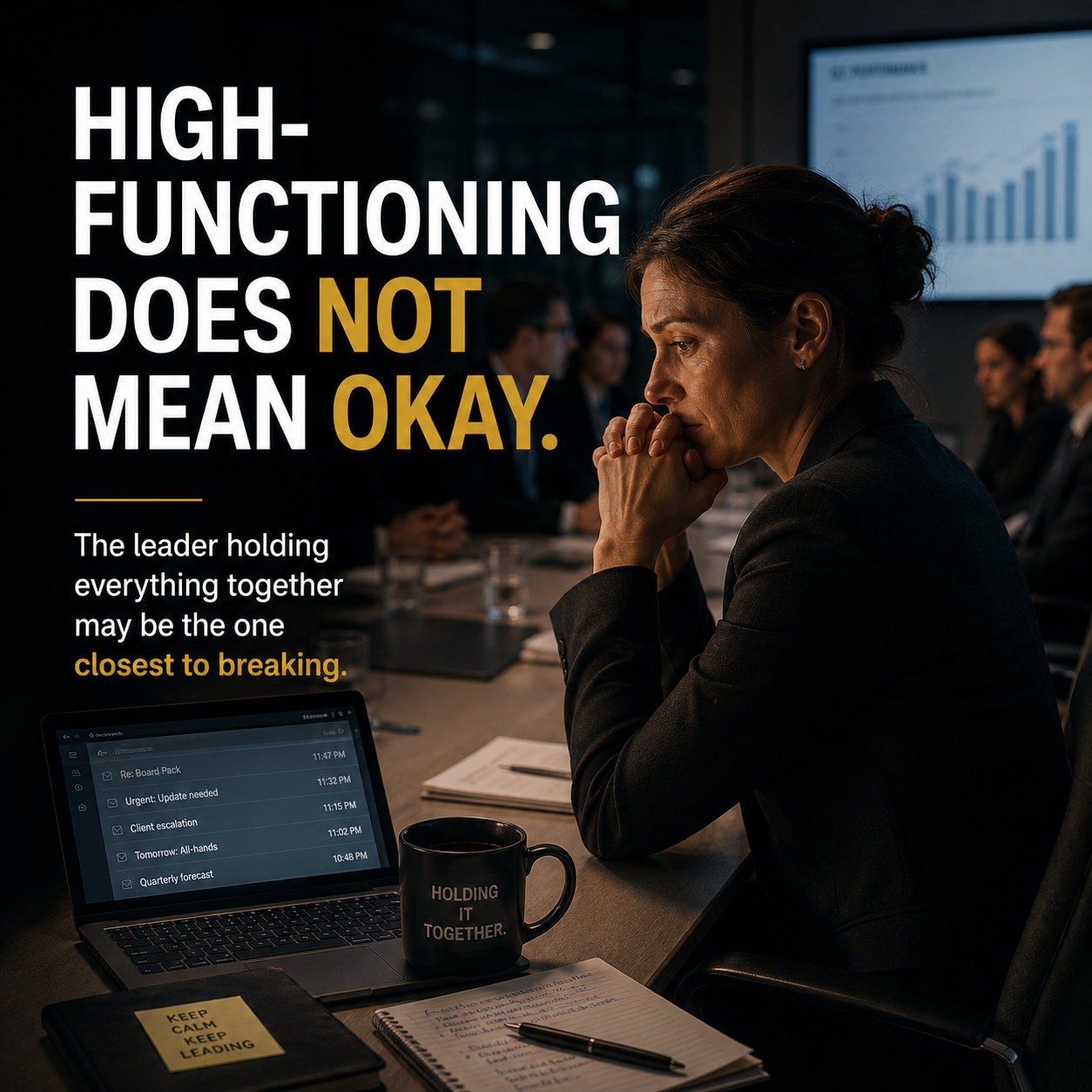
THEY THINK YOU'RE COPING. YOU'RE JUST HIDING IT WELL.
You are the one people come to. You are the one who stays calm when the room is not calm. You are the one who figures it out, who holds the team together, who makes the hard calls, who stays late, who smiles at the all-hands even when the quarter has been brutal.
And you have been doing it long enough that nobody, including you, has stopped to ask what it is actually costing.
The High-Performer Trap
High-performing leaders are the people least likely to be identified as struggling, and the most likely to be harmed by it. The same traits that make someone effective, the drive, the conscientiousness, the capacity to absorb pressure, also make them extraordinarily good at hiding the cost of absorbing it.
The clinical term for what many of them are doing is masking: adapting external presentation to meet environmental demands while the internal experience diverges significantly from what is being displayed. It is an enormous amount of cognitive and physiological work, and it is largely invisible.
Organisations tend to reward this. A leader who masks distress well appears composed, reliable, high-performing. The masking is taken as evidence that everything is fine. And so the conditions that are causing the distress continue, because no one has been given data that suggests anything needs to change.
The leader who appears to be managing everything perfectly is often the last person anyone thinks to check on. And frequently the first to break.
What 'Hiding It Well' Actually Costs
There is a short list of things that chronic masking and sustained high load do to a person's cognitive and physiological functioning: reduced decision-making quality, diminished creative capacity, increased emotional reactivity, impaired interpersonal attunement, compromised immune function, and a growing difficulty distinguishing between genuine signals and background noise.
None of those show up in a performance review.
They show up in the edges: the slightly shorter fuse, the less creative solution, the missed nuance in a difficult conversation, the increasing preference for avoiding complexity rather than navigating it. The slow narrowing of the person to a functional version of themselves.
And then, at some point, the functional version stops functioning.
Why This Is an Organisational Problem, Not a Personal One
It is tempting to frame this as a matter of individual capacity. Some people are built for this. Some are not. That framing is both scientifically wrong and organisationally convenient.
The research on leadership burnout and psychosocial risk is unambiguous: the conditions of work, not the character of the worker, are the primary drivers of psychological harm. Job demands, low control, poor support, lack of role clarity, and inadequate organisational change management are all structural features of how work is designed, not individual personality variables.
When a high-performing leader burns out, the default response is almost always to focus on the individual: what could they have done differently, what support do they need, how do they recover. The structural question, what about this organisation's design made that outcome likely, is almost never asked with the same urgency.
Under current Australian WHS psychosocial safety legislation, the structural question is the one the regulator will ask.
What Organisations Can Do Differently
The starting point is building the capacity to see what is currently invisible. That means creating conditions where leaders can give honest signals about load, capacity, and wellbeing without that honesty being interpreted as a performance issue or a leadership gap.
It also means conducting the kind of systematic psychosocial risk assessment that looks at role design, workload distribution, management support structures, and change management processes, not just at whether people report feeling good about their work.
The hidden cost of ignoring this is not hidden indefinitely. Eventually it becomes a workers compensation claim, a resignation, a performance failure, or a regulator's finding. The cost was always there. The organisation just was not counting it.
If you are a leader who has been holding it together long enough that you have stopped knowing what 'together' actually feels like, the Burnout Audit is the honest starting point. Seven dimensions. No fluff. Find it at unapologeticedge.com/burnout-audit.
FAQS
Why are high-performing leaders more vulnerable to burnout?
High-performing leaders often carry greater responsibility, absorb team pressures, work longer hours and feel a stronger obligation to remain composed under stress. These factors can increase burnout risk.
What is leadership burnout?
Leadership burnout is a state of physical, emotional and cognitive exhaustion caused by prolonged workplace stress and sustained responsibility.
What is masking in leadership?
Masking occurs when a leader maintains an outward appearance of confidence, competence and composure while experiencing significant internal stress, fatigue or distress.
What are signs of leadership burnout?
Common signs include exhaustion, irritability, brain fog, emotional detachment, reduced creativity, decision fatigue and difficulty switching off from work.
Can high-performing leaders burn out?
Yes. High-performing leaders are often at increased risk because they are skilled at continuing to perform despite significant stress and fatigue.
Is leadership burnout a personal failure?
No. Research consistently shows that workplace conditions, job demands, role clarity, support structures and organisational systems play a significant role in burnout risk.
