
Does an EAP Meet Psychosocial Safety Requirements? What Australian Employers Need to Know
What You Need To Know
An Employee Assistance Program (EAP) is not a psychosocial safety strategy.
Australian WHS legislation requires organisations to identify, assess, control and review psychosocial hazards such as excessive workload, poor role clarity, low job control, workplace conflict and inadequate support.
An EAP supports workers after harm occurs.
Psychosocial safety seeks to prevent harm occurring in the first place.
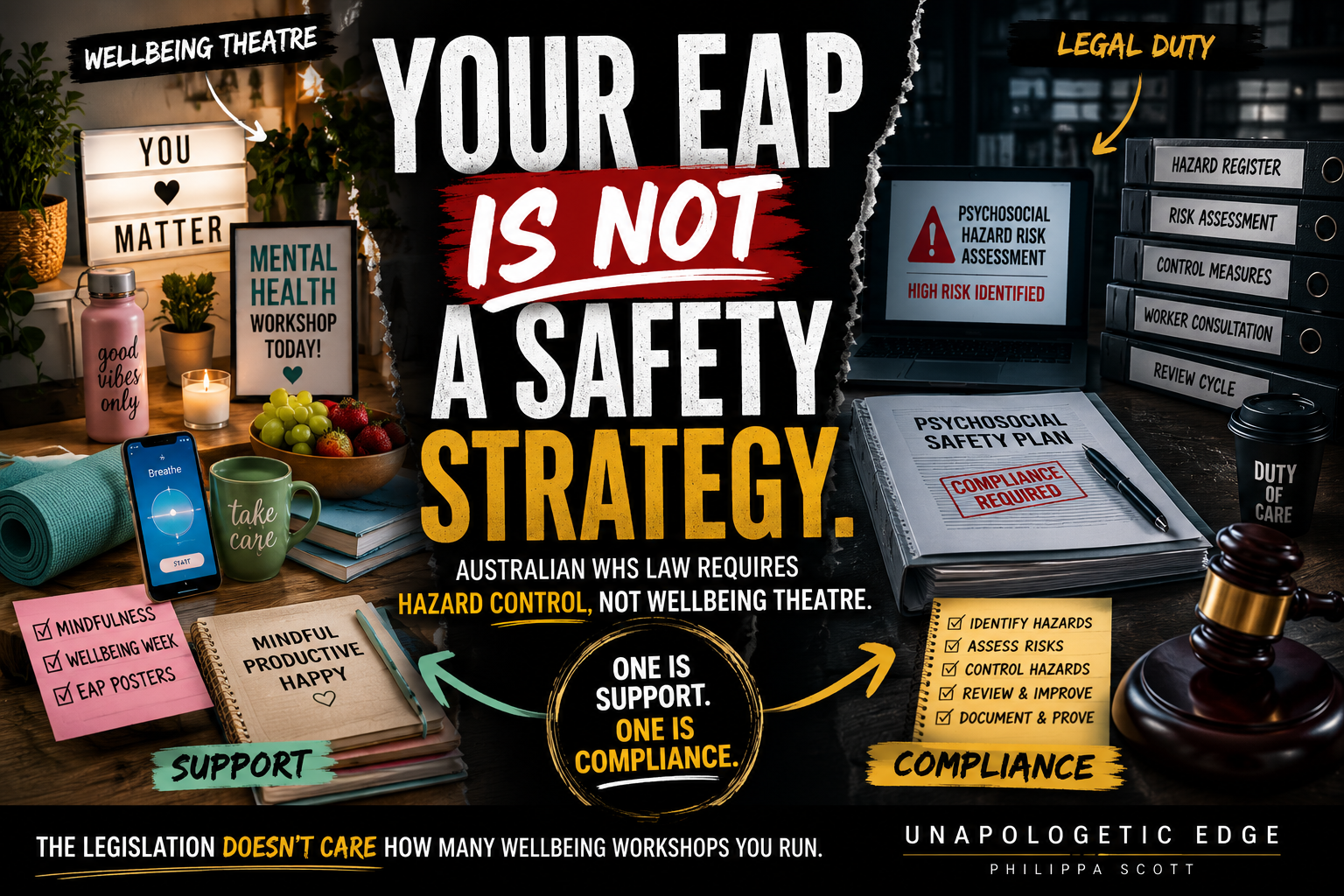
Here is a number that should keep People and Culture professionals up at night: most Australian organisations have an Employee Assistance Programme, a mental health day policy, and a mindfulness app subscription. Most of those same organisations are not compliant with their psychosocial safety obligations under the Work Health and Safety Act.
That is not a criticism. It is a category error. And it is costing organisations real money, real productivity, and real people.
What the Law Actually Requires
Since the model WHS Regulations were amended in 2023, Australian employers have had a positive duty to identify, assess, and control psychosocial hazards in the workplace. Not respond to them after the fact. Not offer support services. Control them.
The legislation names14 specific hazardcategories, including job demands, low job control, poor support, lack of role clarity, poor organisational change management, remote or isolated work, and workplace violence and aggression, among others.
An EAP addresses the person after harm has occurred. The legislation requires you to address the conditions that cause harm in the first place. Those are two fundamentally different obligations.
“An EAP is a downstream response. Psychosocial safety is an upstream system. Confusing the two is not just a strategic error. It is a legal one.”
Why Organisations Keep Making This Mistake
The confusion is understandable. For decades, workplace mental health was framed as an individual problem with individual solutions. Someone burned out? Refer them to counselling. Someone struggling? Activate the EAP. The organisation's job was to provide the resource.
The new legislation has moved the goalposts significantly. Psychological harm is now treated the same as physical harm under WHS law. You would not respond to a broken staircase by offering physiotherapy to everyone who fell down it. You would fix the staircase.
Psychosocial hazards work the same way. The obligation is to identify and eliminate or minimise the hazard, not to treat the injured.
The challenge is that most organisations have not updated their mental health frameworks to reflect this shift. Their policies still speak the language of individual support. Their risk registers still treat psychological injury as a welfare matter rather than a safety matter. And their P&C teams are often carrying the full weight of compliance without the legal literacy or executive mandate to drive structural change.
What a Compliant Organisation Actually Looks Like
Compliance starts with a systematic hazard identification process that covers all 14 categories. This is not a staff survey asking people whether they feel supported. It is a structured risk assessment that examines job design, workload distribution, management practices, reporting structures, and the physical and social conditions of work.
From there, a compliant organisation has documented controls, a review cycle, and evidence that workers were consulted in the process. The Code of Practice is explicit: consultation is not optional.
This is upstream work. It requires executive commitment, not just HR effort. And it requires someone in the room who understands what the legislation actually says, not just what the wellness industry has told you it means.
The Cost of Getting This Wrong
Regulators are actively investigating psychosocial safety compliance. Significant penalties apply for organisations that fail to meet their WHS obligations. Beyond the legal exposure, the business cost of unmanaged psychosocial risk includes workers compensation claims, absenteeism, presenteeism, turnover, and the slow erosion of the kind of discretionary effort that you cannot mandate in a policy.
Your EAP is valuable. Keep it. But stop counting it as your psychosocial safety strategy.
The two things are not the same.
If you are a P&C leader or senior executive unsure where your organisation actually sits against the 14 hazard categories, the Psychosocial Safety Review is where to start. It covers all 14 WHS hazard categories plus neurodivergent load, masking, and perimenopause as explicit risk dimensions. Book a strategy call.
FAQ: Psychosocial Safety and EAPs
Is an EAP enough to meet psychosocial safety obligations?
No. An Employee Assistance Program provides support after a worker experiences distress or harm. Australian WHS legislation requires employers to identify, assess, control and review psychosocial hazards before harm occurs.
Does Australian law require psychosocial risk management?
Yes. Australian Work Health and Safety legislation requires employers to manage psychosocial hazards using the same risk management approach used for physical hazards.
What are psychosocial hazards?
Psychosocial hazards are aspects of work design, management, workplace relationships or working conditions that create a risk of psychological or physical harm.
What is the difference between wellbeing and psychosocial safety?
Wellbeing programs support individuals. Psychosocial safety focuses on identifying and controlling workplace conditions that create harm. The two work together but they are not interchangeable.
What happens if an organisation fails to manage psychosocial hazards?
Organisations may face regulatory action, workers compensation claims, legal liability, increased turnover, absenteeism and reduced productivity.
