
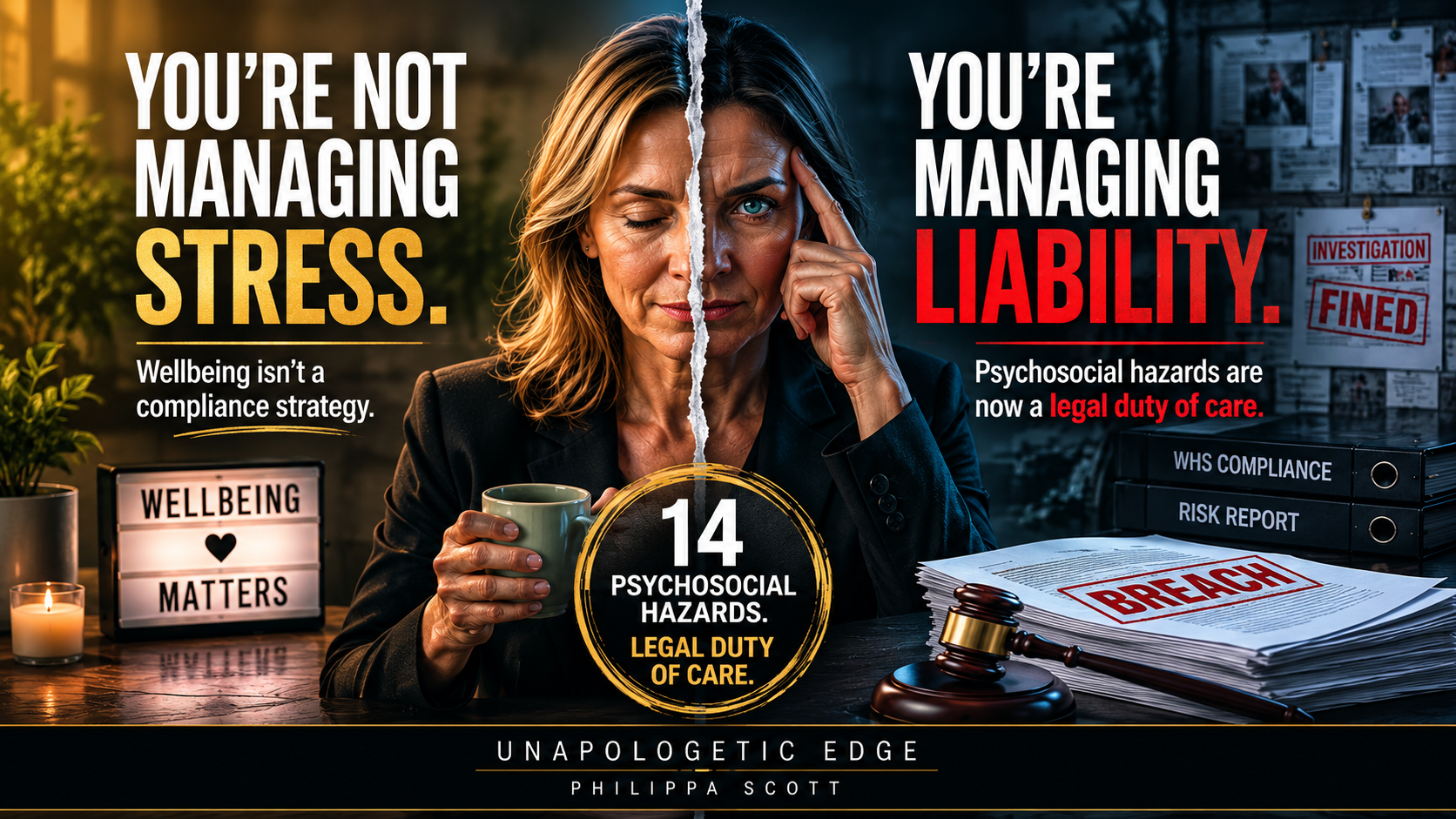
You're Not Managing Stress. You're Managing Liability.
What Australian leaders need to know about psychosocial safety law, and why most organisations are significantly behind.
Here's a question worth sitting with.
If someone audited your organisation tomorrow, specifically against Australia's current psychosocial safety obligations, how confident would you be in what they found?
Not 'we have an EAP' confident. Not 'we did a wellbeing survey last year' confident. Actually confident. The kind of confidence that would hold up against a WorkSafe inspection, a WorkCover claim, or a conversation with a lawyer who specialises in this area.
For most of the leaders I work with, that question produces a long pause.
Not because they don't care. They care enormously. But because there is a significant gap between what most leaders think Australian WHS law requires and what it actually requires.
This post closes that gap.
What Changed in 2023
In 2023, Safe Work Australia updated the model Work Health and Safety regulations to include explicit, enforceable provisions around psychosocial hazards.
The practical effect of that change is this: psychosocial risk is now a legal duty of care obligation in the same category as physical safety. The same framework that applies to a faulty piece of machinery, an unsafe work practice, or a hazardous substance now applies to the psychological conditions in your workplace.
That means the chronic overwork that's become normalised in your team is not a morale issue. It's a compliance issue.
The manager whose communication style leaves people walking on eggshells is not a culture issue. It's a compliance issue.
The always-on culture where nobody actually disconnects is not a work-life balance issue. It's a compliance issue.
Psychosocial risk is no longer a wellbeing aspiration. It is a legal obligation. And most organisations are behind.
The legislation identifies fourteen specific categories of psychosocial hazard that organisations are required to identify, assess, control, and review. Most organisations I work with are actively managing zero of them. Some are managing one or two, usually workload, usually by asking people to flag when they're struggling.
That is not a psychosocial safety management system. That is a bucket under a leaking roof.
The Fourteen Psychosocial Hazard Categories
The fourteen categories named in the legislation are:
Job demands (workload, pace, complexity)
Low job control (limited autonomy over how work is done)
Poor support from supervisors or colleagues
Lack of role clarity
Poor organisational change management
Inadequate reward and recognition
Poor organisational justice
Poor workplace relationships
Remote or isolated work
Poor physical environment
Violence and aggression
Bullying
Harassment, including sexual harassment
Conflict and unresolved interpersonal tension
Most leaders, when they see this list for the first time, have a specific reaction. It's somewhere between recognition and mild panic. Which is appropriate.
Because the list is not describing edge cases. It's describing the conditions that exist in most Australian workplaces, to varying degrees, most of the time.
The question is not whether these hazards exist in your organisation. The question is whether you know which ones, how severely, and what you're doing about them.
Why Leaders Are Both the Problem and the Solution
Here's the part that requires some honest reflection.
The primary vector for most psychosocial hazards in a workplace is leadership behaviour. Not because leaders are bad people. Because leadership behaviour sets the conditions for everything else.
The leader who sends emails at 11pm is not just someone who works late. They're creating a hazard around role ambiguity and recovery time. Whether they intend to create that pressure is irrelevant to its impact.
The executive who praises people for going above and beyond during a crunch is not just being encouraging. They're reinforcing the norm that extraordinary effort is the baseline expectation. Over time, that becomes a workload hazard.
The manager who is unpredictable under pressure is not just someone who needs to work on their emotional intelligence. Their direct reports are managing a threat response in every difficult conversation, and that is a measurable psychosocial stressor.
None of these people intend harm. But under the current legislation, intention does not mitigate impact. Impact is what you're assessed on.
The same influence that creates the hazard is the influence that can dismantle it. That's not a burden. It's actually the best news in this entire post.
What the Legislation Actually Requires
The WHS psychosocial safety framework uses a risk management approach. The same four steps you'd apply to any physical hazard.
Identify.
You need evidence of which hazard categories exist in your organisation. Not which ones you suspect. Which ones actually exist, based on data.
Assess.
You need to understand the severity, frequency, and reach of each identified hazard. Who is affected, in what conditions, with what intensity.
Control.
You need to implement measures that reduce or eliminate the hazard. Not measures that help people cope with it. Measures that change the conditions generating it. There is a meaningful difference.
Review.
You need to check whether your controls are working and adjust when they aren't. This is not a one-time exercise. It's an ongoing obligation.
This is the standard. And it is a different standard to what most organisations currently have.
Most organisations have an EAP. A wellbeing program. An engagement survey. These are valuable. They provide genuine support to individuals. But they do not constitute a psychosocial safety management system, and they do not discharge the legal obligation.
Knowing the difference between individual support and structural risk management is the most important thing a leader or P&C professional can understand right now.
What to Do With This
If this post has created more questions than it's answered, that's the right response. Psychosocial safety is a new area of compliance for most organisations, and the gap between current practice and legal obligation is real and significant.
The organisations that will manage this well are not the ones that are most alarmed by the list. They're the ones that get systematic about it first.
A useful starting point is knowing where the load is actually sitting in your own experience. If you're a leader who is managing psychosocial risk while also quietly carrying significant psychosocial load yourself, that matters. The Burnout Audit takes five minutes and will show you which dimensions are currently highest. It's free and it's in the link below.
If you're ready for a more structured conversation about what a genuine psychosocial safety management process looks like for your organisation, a strategy call is the right next step.
Take the free Burnout Audit → Link
Book a strategy call → Link
Prefer to listen?
This post is the companion piece to Episode 7 of the Unapologetic Edge podcast: You're Not Managing Stress, You're Managing Liability. The episode goes deeper on the legislative context, the leadership behaviour piece, and what a genuine risk management process looks like in practice. Available wherever you get your podcasts, and in the link below.
