
You're not resilient. You're just really good at enduring.
Resilience and capacity are not the same thing. Confusing them is quietly bankrupting some of the most capable people in the room.
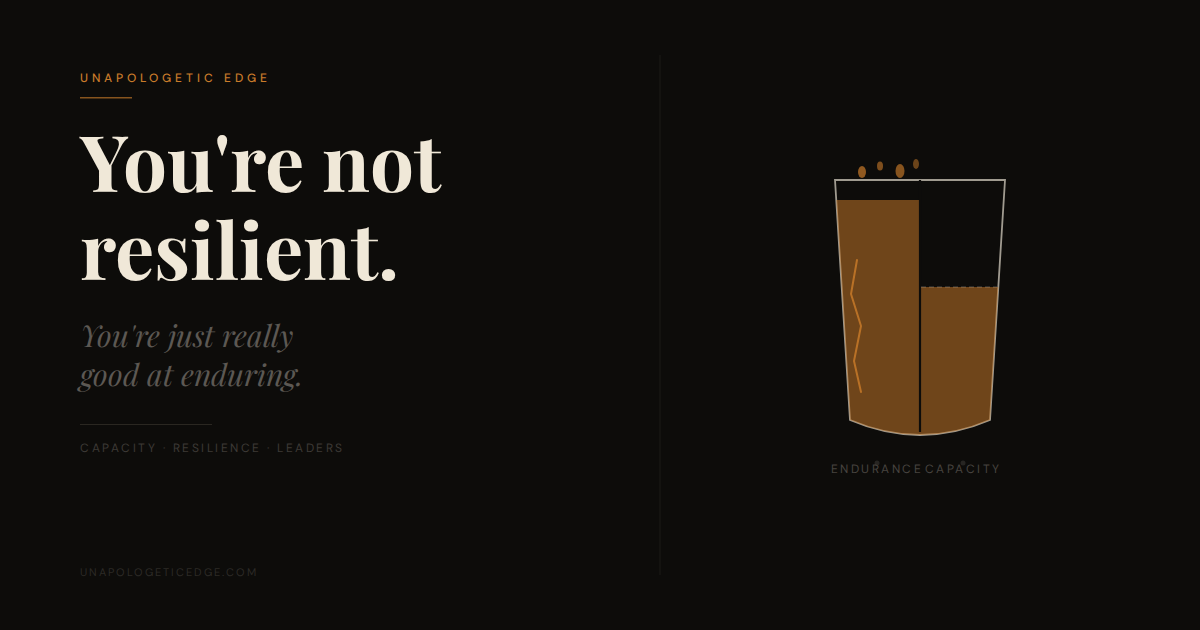
Let's start with the uncomfortable question: How many of us have mistaken survival for resilience?
Because most of us have. Especially leaders — and those in the helping professions more broadly: coaches, therapists, facilitators, people who lead others through hard things for a living. We've become so practised at bouncing back that we've stopped noticing the thing we keep bouncing back from is our own unsustainable life.
This isn't a character flaw. It's a category error. And category errors are fixable — once you can see them clearly.
"Resilience without respect for capacity doesn't make you strong. It makes you someone who's very good at enduring things that probably shouldn't be endured."
Two different things, living in the same sentence
People use these words interchangeably. Leaders especially. And it matters, because they point to entirely different internal experiences — and they create very different lives.
Resilience
Your ability to return to centre
Recovery after difficulty
Flexibility under pressure
Adaptation to change
Healthy boundaries
Support systems
Active restoration
"That was hard. I need to replenish."
Capacity
How much you can realistically hold
Shaped by sleep & health
Affected by grief & hormones
Shifted by stress & life stage
Influenced by support
Changed by cognitive load
Not fixed — ever
"This is what I can realistically hold today."
Notice the difference? Resilience is about recovery. Capacity is about container size. And neither one is the full picture without the other.
Where leaders quietly come unstuck
Here's what I see again and again: genuinely remarkable resilience, combined with a near-total blindness to actual capacity.
Leadership culture actively rewards this. The mantras sound familiar. I can handle it. I'll get through. I always do. People are counting on me. And they're not wrong — you probably will get through. You're excellent at getting through. The question is what you're getting through to.
Eventually, these are leaders who are recovering well from lives they never actually had the capacity to sustain. They've become elite-level endurers. And somewhere along the way, they rebranded it as resilience — because resilience sounds admirable, and endurance sounds like a survival strategy, which it is.
"The trap isn't weakness. The trap is being so skilled at recovery that you never stop to ask whether the thing you're recovering from should exist at all."
The trap runs both ways
To be fair, the opposite failure is just as limiting. Capacity without resilience becomes fragility. If you're acutely aware of how full your container is but have no ability to flex, adapt, or move through difficulty — that's not self-awareness, that's brittleness.
What we're actually after is the combination: enough resilience to move through genuine challenge, and enough self-awareness to know when the container is simply full. Not stretched. Full.
There's a distinction between bending and breaking. There's also a distinction between bending and never getting to straighten up.
Sit with these
What are you currently calling resilience that might actually be overextension?
Where have you increased your ability to cope instead of actually changing the conditions?
If you genuinely honoured your real capacity this month, not your aspirational capacity, your actual one, what would need to change?
That third question is the one that tends to land quietly and then get very loud at about 3am.
Because most of us don't need to become someone who can carry more. We need to become someone who knows when enough is enough. Someone who can tell the difference between a moment that calls for digging in, and a moment that's calling for something to be put down.
That's not weakness. That's wisdom. And in a world that endlessly applauds leaders for carrying more, choosing to carry less can be the most radical, unapologetic thing you do.
Maybe the goal isn't becoming someone who can carry more.
Maybe the goal is becoming someone who knows when enough is enough.
